
How to Golf: The Complete Beginner’s Guide for New Players
Golf has a reputation for being intimidating, expensive and full of unwritten rules. None of that is entirely wrong, but none of it has to stop you from playing well enough to enjoy your first season. The fundamentals — what to put in your bag, how to take a real swing, when to chip versus pitch, how to behave on the course, what counts as a penalty — fit into a much smaller package than the game’s reputation suggests.
This guide walks through how to golf from the first decisions you’ll make (what to buy, where to take lessons) all the way through your first organized outing. It’s written for someone who has either never played or has hacked around a driving range a few times and now wants to do this properly. Practical verdict: don’t try to optimize everything at once. Get a small set of forgiving clubs, take two or three lessons before bad habits set in, learn to chip and putt before you fall in love with the driver, and play a short course before you set foot on an 18-hole layout. That order saves time, money and frustration.
Building a Starter Set of Clubs

The bag rules allow up to 14 clubs, but a beginner doesn’t need anywhere near that. A working starter set is six or seven clubs — enough to handle every shot a new player will face, light enough to carry, and cheap enough to assemble without draining a paycheck.
The core set looks like this: a driver, a putter, a sand wedge (look for “S” stamped on the sole, or a loft between 54 and 56 degrees), a pitching wedge, a 6-iron, an 8-iron, and either a fairway wood or hybrid in the 18–21 degree loft range. These are the most forgiving clubs in any bag, and they cover tee shots, approach shots, short-range play and putting. Used titanium drivers run around $75 in 2026, sometimes less. Putters can be picked up for under $30 if you shop the discount racks at larger golf and sporting goods stores.
Why Loft Is Your Friend
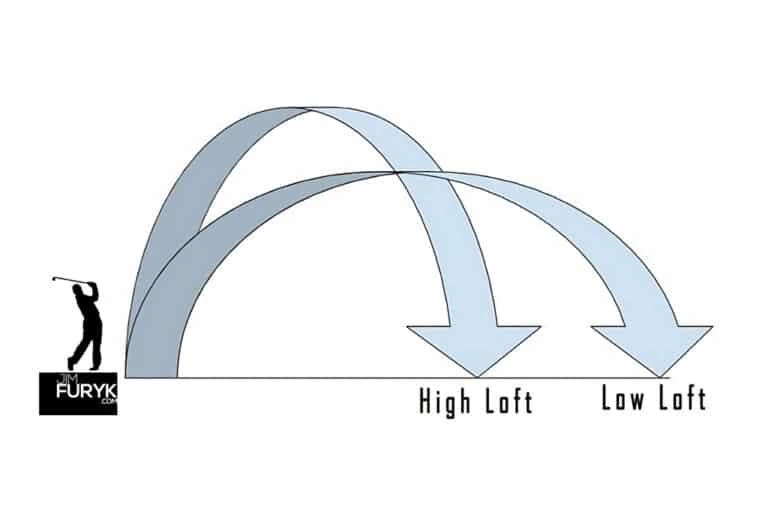
Unless you come from a stick-and-ball background — baseball, hockey, tennis — go with more loft on your woods, not less. A driver with 10 degrees of loft (or more) gets the ball airborne more reliably and reduces sidespin, which means straighter shots. Fairway woods that start at 17 degrees do the same job better than the 15-degree options you’ll see marketed at experienced players. The trade-off is a few yards of distance, which doesn’t matter when you’re trying to make consistent contact.
Hybrids and Wide-Soled Irons

Skip the long irons. The 3-iron, 4-iron and 5-iron are among the hardest clubs in golf to hit for a new player, and there’s no reason to fight them when hybrids exist. Hybrids do the same job — covering the 180–220 yard range — with much more forgiveness. For the irons you do carry, look at the sole width. An iron sole roughly two fingers wide (front edge to back) tells you it’s built for game improvement. A sole less than a finger wide is a player’s iron, and those should stay on the shelf unless you’re getting paid to play.
Shaft Flex Without Guessing
Before buying a full set, go to a large golf shop or driving range and hit a 6-iron with regular-flex and stiff-flex shafts. One will feel noticeably easier to control. Generally, faster and more aggressive swings prefer stiff (S). That’s the flex you start with across the bag. A full clubfitting becomes worth the money later, once you’re making consistent contact — typically after a season or two of regular play.
A Word on Golf Balls
Buy balls on a sliding scale based on how many you lose per round. If you’re losing two sleeves or more per round, stick to balls around $20 a dozen. Once you’re down to three-to-five lost balls per round, you can move into the under-$30 range. Anything over $40 a dozen is for players who lose fewer than three balls a round, which won’t be you for a while.
Learning the Game the Right Way

The hardest part about getting into golf is the start. Before you spend anything on instruction, ask yourself why you’re picking up the game. Is this for work or social reasons — meaning you need to be functional but not great? Or do you want to take it seriously and improve fast? Those two paths look very different in terms of time, money and lesson volume.
Take Lessons Early
The single best decision a beginner makes is taking lessons in the first few weeks rather than after a year of self-taught swings. The reasoning is simple: you haven’t ingrained bad habits yet, you have an honest list of questions, and a good PGA professional can show you what you’re doing right as quickly as what you’re doing wrong. Beginners who try to learn from YouTube and friends for six months end up paying more in eventual lessons because the instructor has to undo damage first.
Look for a teacher whose personality fits yours. A creative, feel-based player won’t enjoy a teacher who only talks about angles and shaft planes. A methodical, technical player won’t get much from a “just swing it” instructor. The right fit lets you ask questions you think are stupid, which is where most real learning happens.
Range Routine, Not Range Bombing
Everyone wants to see how far they can hit a driver. Don’t open every range session that way. Start with a wedge or short iron, make half-swings to warm up, then build through the middle irons before pulling the driver. Hit a handful of drivers, then go back to a short iron. This keeps your tempo from collapsing — long, hard swings ruin rhythm faster than anything else in golf.
Half Your Strokes Live Inside 50 Yards
Roughly half of every round happens within 50 yards of the green. That means your practice time should split that way too, even if it feels less satisfying than crushing drivers. The short game can be practiced almost anywhere: buckets in the yard at different distances, pitches off good and bad lies, putts rolled through doorways and around furniture legs to work on aim and pace. None of that requires a range or a fee.
The Basic Shots You Need to Own
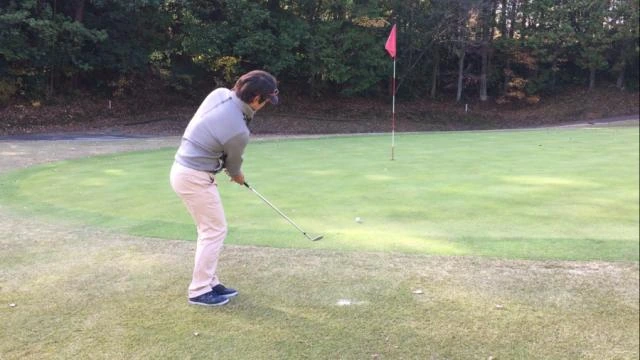
There are parts of the game that take years to develop, but a small set of shots covers most situations a beginner faces. Marcus Halliday, a teaching professional who runs junior clinics in the Midwest, puts it simply: if you can tee off without panic, get out of a greenside bunker, chip the ball onto the green and two-putt, you can play golf. Everything beyond that is refinement.
Chip Versus Pitch
A chip stays low and runs along the ground. A pitch flies higher and stops faster. Use a chip when there’s no obstacle between your ball and the green and you have plenty of green to work with. Use a pitch when you need to carry something — deep rough, a bunker — or stop the ball quickly on a tight pin. New players default to one or the other for everything. Learn both early and your scoring improves immediately.
Greenside Bunker
The greenside bunker shot is the one swing in golf where you don’t actually hit the ball. The clubhead enters the sand about two inches behind the ball, and the sand pushes the ball out. Because sand slows the clubhead dramatically, you swing harder than you’d expect.
Set up with your sand wedge, ball even with your front instep, feet twisted into the sand for stability. Focus your eyes on the spot behind the ball, not the ball itself. Swing the club back about halfway, then down and through the spot. Keep turning until your chest faces the target at the finish. Beginners who quit on the shot leave the ball in the bunker — commitment matters more than technique here.
Using Your Driver Without Fear
The driver looks intimidating because it’s long and the head is large, but that head is also the most forgiving in your bag for off-center hits. Tee the ball high — higher than feels natural. Make a smooth backswing with a full body turn so your back faces the target. Let the ball get in the way of the clubhead rather than swinging at it. Hold your finish in balance. If you can’t finish balanced, you swung too hard.
When in Doubt, Chip
The chipping motion is the entire golf swing in miniature, which is why teachers send frustrated students back to it. Ball back in the stance, more weight on the front foot, equal-length swing back and through, no wrist hinge. Once that feels smooth, lengthen the swing and add a little wrist hinge upward. The full swing builds out of the chip, not the other way around.
Stepping Onto a Real Course

Once you can make consistent contact at the range, the course is the next step — but not any course.
Start Small
A par-3 or executive course is built for what you can currently do. On a par-3 course, every hole is under 200 yards. Executive courses mix shorter par 4s and 5s with multiple par 3s. Either format keeps you out of the 180-yard approach shots that punish beginners. There will be time for full championship layouts later.
Three Holes Is Enough
Golf is its own kind of endurance sport. Eighteen holes the first time out is a near-guaranteed bad experience. Play three holes on a nine-hole course late in the afternoon when the course is quieter and rates often drop. If the course won’t sell a three-hole rate, play until you start getting frustrated and walk in. Come back another day.
Play From the Forward Tees
Ego is the most expensive thing a new golfer carries. Playing the course at 5,500 yards or less — the forward set of tees — cuts time, frustration and lost balls. The national push in recreational golf has been toward shorter distances for players of every level, including good ones. There’s no scoreboard rewarding you for playing the back tees badly.
Keep the Pace
Most courses ask for a four-and-a-half hour round. As a beginner, the cleanest way to keep pace is to cap your strokes per hole — a maximum of seven works well — and pick up your ball when you hit that number. Your playing partners will thank you. Picking up isn’t shameful; holding up the group behind you is.
Etiquette Without Memorizing a Rulebook
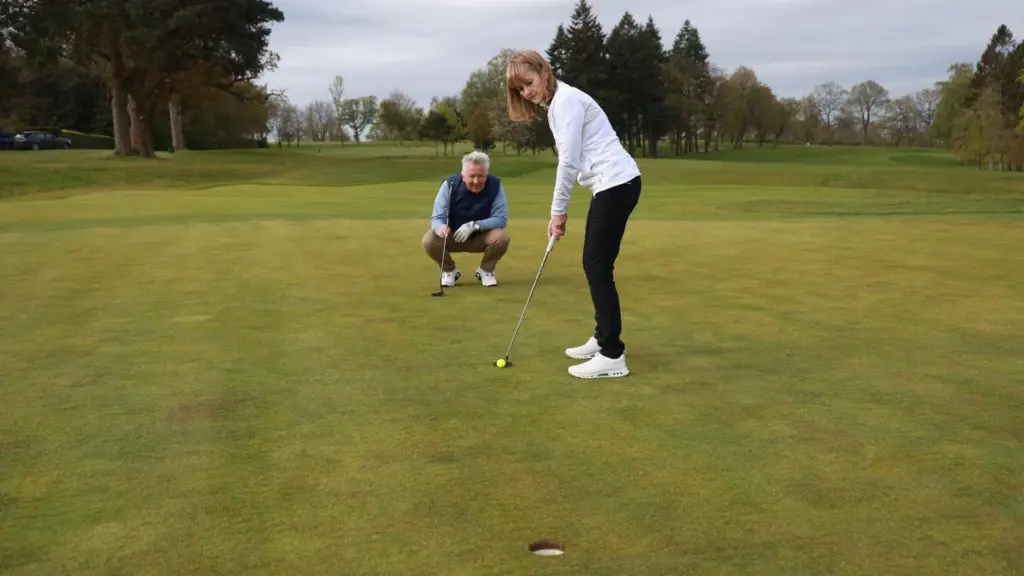
Golf etiquette feels complicated until you realize most of it boils down to two ideas: don’t slow people down, and don’t hit anyone with a golf ball. The rest is detail.
The fastest way to be welcomed in any group is pace of play. Take one or two practice swings, not five. Be ready to hit when it’s your turn. Talk between shots, not during them. A useful self-check: stay no more than half a hole behind the group in front of you.
Order of play traditionally goes by honor — whoever scored best on the previous hole tees off first. From there, the player furthest from the hole hits next. Many casual groups switch to “ready golf,” where anyone ready can hit. On the green, the player closest to the hole handles the flagstick.
When a ball goes off line and could come near anyone, shout “Fore!” — at full volume, immediately, with direction if you can (“Fore right!”). Don’t wait, don’t second-guess. The warning is the point.
Take care of the course. Replace divots in the fairway or fill them with seed mix. Fix ball marks on the green; ask a playing partner to show you how if you’ve never done it. Rake the bunker after you hit out. Find out whether carts are allowed on the grass or stay on the path, and never drive a cart near the putting green.
Where you stand matters because golf is played with blunt objects. Stay to the side and slightly behind the ball, several yards away. On the green, stay out of the line of sight of whoever is putting, and don’t walk on the line between any player’s ball and the hole.
The Rules You Actually Need
The Rules of Golf runs 182 pages. Most recreational golfers know almost none of them and play fine. Five rules cover the vast majority of situations a beginner faces.
- Don’t move your ball. Play it as it lies unless an obstruction — a man-made object like a yardage marker — is interfering. On the green, mark your ball with a coin or marker before lifting it.
- Don’t pick up a ball that isn’t yours. Other players’ shots end up in odd places too.
- If your ball lands in another fairway that isn’t marked out of bounds (white stakes or lines), play it from there. Let the group on that hole play through unless they wave you on.
- You get five minutes to look for a lost ball. After that, take a one-stroke penalty and play another shot from as close as possible to your last position. To drop, extend your arm at shoulder height and let the ball fall.
- Out of bounds (white stakes or lines) means a one-stroke penalty plus playing again from the original spot. If you tee off out of bounds, your third shot comes from the tee.
Getting Into Golf Shape
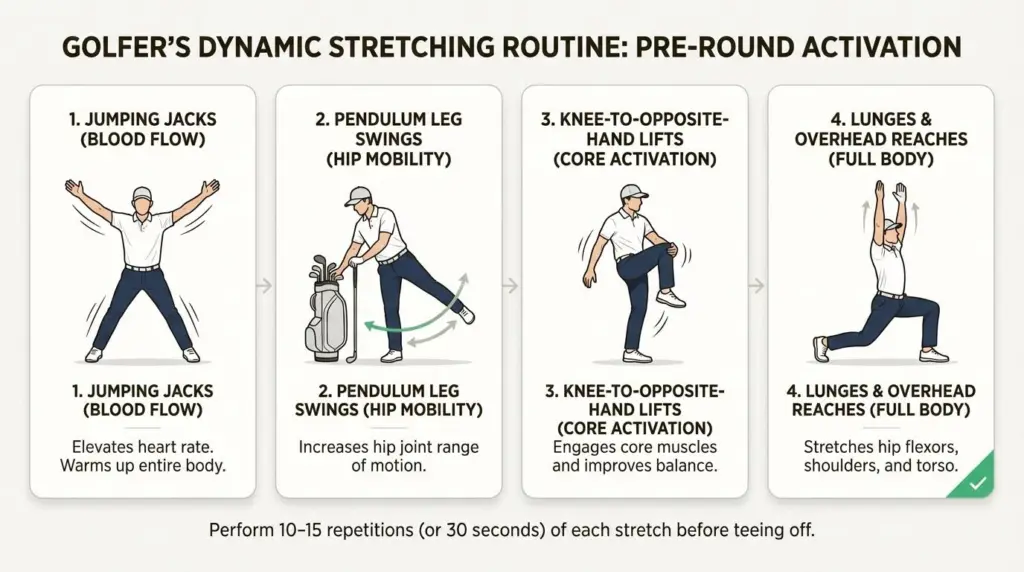
Tour pros don’t swing the way they do because of natural gift. Strong hip muscles, flexible hamstrings and a stable back are what allow the swing to work, and most amateurs are missing one or more of those.
Walk the course when you can, instead of riding. A full round on foot with a light carry bag is roughly seven miles, which feels brutal the first few times and easier each round after that. Lightweight bags with pop-up stands make this realistic.
Stretching matters, but timing matters more. Save long holds for after the round or at night. Before playing, use dynamic stretches that wake the muscles up — leg swings, torso rotations, arm circles. Ten kicks per leg, trying to get higher each time, is more useful than a static hamstring stretch on the first tee.
Food on the course is mostly trouble. Burgers, dogs, chips and granola bars don’t help. Lean protein and complex carbs — chicken, turkey, a banana, bran cereal — keep energy and concentration steady. Eat before the round, eat again at the turn, and drink water constantly. If your urine isn’t clear, you’re already behind on hydration.
Training the right muscles means everything from the knees to the chest. Squats, lunges and planks are the foundation. Strong, flexible hamstrings, hip flexors, glutes, abs and lats produce both power and protection from injury.
What to Wear
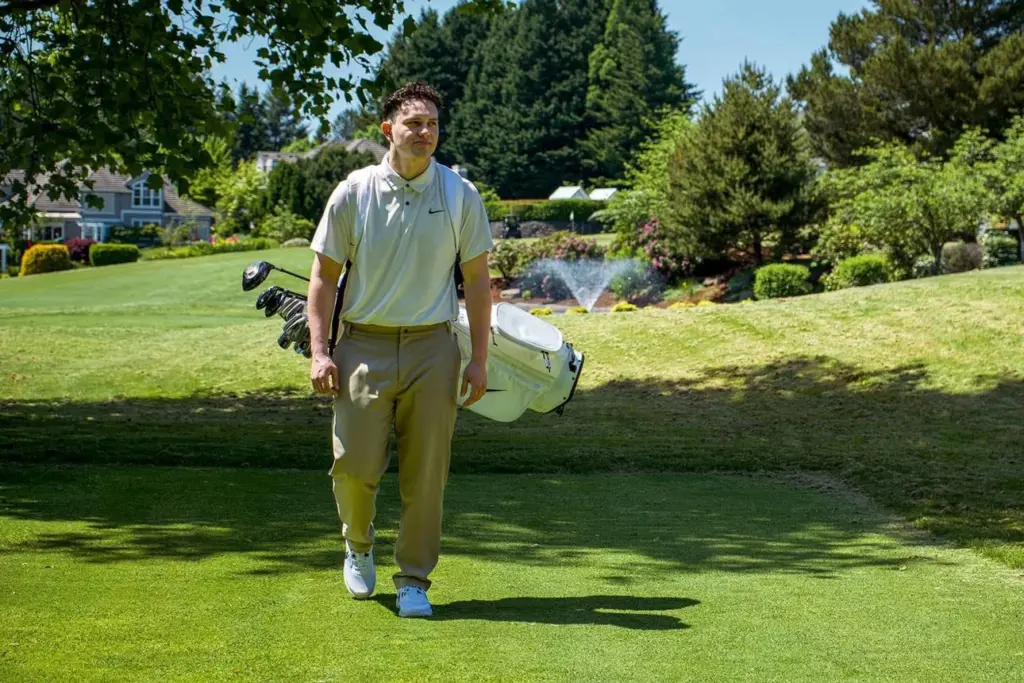
Most courses enforce a dress code, some stricter than others. Getting this wrong on a first visit is embarrassing in a way the swing isn’t.
Men almost always need a collared polo. Cotton works for traditional cuts and cooler weather; technical fabrics from Adidas, Nike or Callaway wick moisture better when it’s hot. Khaki pants are the safest bet for legs — breathable, comfortable, accepted everywhere. Most courses allow shorts, though some are particular about cargo shorts. Jeans are best left at home, even at courses that technically allow them.
Sun protection is functional gear, not optional. A baseball cap or visor, wraparound sunglasses that block UVA and UVB, and SPF 30 sunblock applied 30 minutes before the round and again at the turn. Spray sunblock at the turn keeps your hands from getting slippery. Lip balm with SPF rounds it out.
Skip golf shoes until you’re committed. Sneakers work for the first season — just not running sneakers, which have too much cushion under the heel and tilt you out of balance. A dry towel and a rain jacket should live in the bag permanently.
Playing in Your First Outing

The first time you play in an organized event — a charity scramble, a member-guest, a corporate outing — the experience is genuinely different from a casual round. Bobby Jones called it correctly: tournament golf and regular golf barely resemble each other.
Know the format before you tee off. Scrambles and best-ball events reward aggressive play. In a scramble, every player hits, the team picks the best shot, and everyone plays from there. In best ball, each player plays their own ball and the team takes the lowest score on each hole. If your score on a hole won’t count, pick up — don’t hold up your group grinding for an 8 that doesn’t matter.
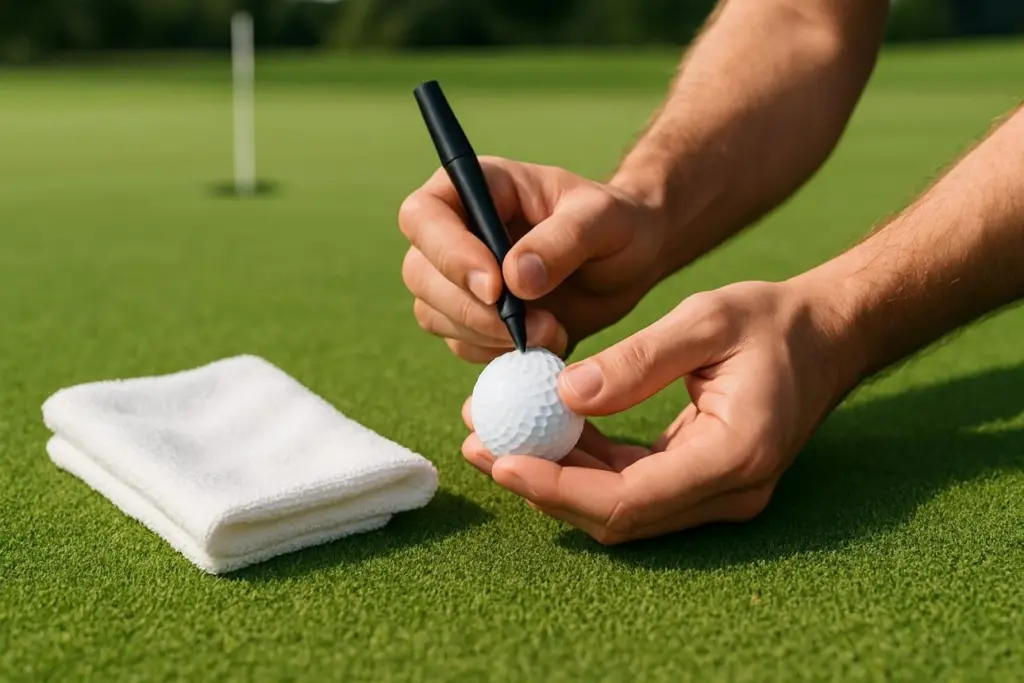
Carry a Sharpie and a coin. Mark your ball with a unique dot pattern so it’s distinguishable from other Titleist 1s in the group. Use the coin to mark on the green; a tee is not enough, and casual marking signals inexperience.
Announce when you’re picking up. Don’t make playing partners wonder whether to wait or move on. A quick “I’m out, hitting the next one” is all it takes.
Keep a sense of humor. No one at a casual outing cares if you shoot 110. They care if you’re pleasant company. Sulking and cursing land worse than bad shots ever do, especially from a new player.
Don’t take a lesson the day before an event. New swing thoughts under tournament pressure produce a worse round, almost without exception. Go with what you have.
What to Do Next
If you’ve read this far, the actual next steps are short. Buy a small starter set — used is fine. Book two or three lessons with a PGA professional in your area. Spend more time on chipping and putting than you want to. Find a par-3 or executive course nearby and play three holes the first time out. Play from the forward tees, keep pace, and pick up when you need to.
The players who stick with golf are almost never the ones who started with the most expensive bag. They’re the ones who learned the short game early, kept their expectations honest, and treated every round as practice for the next one. That’s the path. The rest is just rounds.